OBESITY: The Mother of all Diseases
by Bellamkonda K. Kishore, M.D., Ph.D., MBA
The term obesity is derived from Latin word obesitas, meaning "stout, fat or
plump". Ancient Egyptian and Indian medicines recognized obesity as a medical
disorder. The Indian surgeon Sushruta (6th century BCE), not only recognized
obesity as a disorder, but also related it to diabetes and heart diseases, and
recommended physical work to cure obesity and its effects on health. In ancient
times food was in scarcity, and so obesity was associated with affluence. In
modern times, paradoxically, overweight and obesity are associated with lower
socioeconomic status all over the world. There are many reasons for that, but
the most valid one is processed foods, which are cheaper are not the healthy
foods.
* Prevalence of Obesity: Although there are many reasons why a person is
obese, such as hormonal problems, the most common cause is diet-induced.
Diet-induced obesity is caused by consumption of excessive calories through food
and drinks, than what one can utilize or burn. For example, it is easier to
drink a can of Coke (12 fl oz) containing 150 calories. But to burn 150
calories, one has to walk 45 minute (3 miles) or jog for 19 min or swim for 20
minutes. Overweight and obesity are determined by Body Mass Index (BMI), which
is a unit that relates the height and weight of a person (BMI = m/h2, where m
and h are weight and height in the same type of units; http://www.bmi-calculator.net/
). BMI value less than 18.5 is considered underweight. BMI value between18.5 to
25.0 is normal weight, whereas BMI value between 25.0 and 35.0 is overweight.
BMI values between 30.0 and 35.0 fall under class I obesity, and values between
35.0 and 40.0 are considered class II obesity. BMI values above 40.0 are
considered class III obesity, which is an extreme degree of obesity. By this
definition, according to the World Health Organization (WHO), in 2014 there were
1.9 billion (39%) adults with overweight (BMI > 25), of which 600 million were
obese (BMI > 30). Interestingly, 62% of the overweight or obese persons are in
the developing countries, such as China, India, and South America, and only 38%
live in developed world. What is more alarming is the rise in childhood obesity
in different age groups over the years. As per the WHO, in 2010 more than 40
million children under 5 years age had overweight with 75% of them living in
developing countries. These numbers clearly show that overweight and obesity are
global problems, and are not restricted to the developed world. In fact, people
in the developing countries carry more burden of overweight and obesity than
those in the developed world.
* Health Consequences of Obesity: As the title of this article states,
obesity is the mother of all diseases. Contrary to the common belief, fat is not
just an inert depot of extra calories consumed. Fat tissue, precisely the
adipocyte or fat cell, is metabolically very active. It produces a number of
molecules through which it regulates the body"s ability to store and process
energy and its response to insulin, the hormone that regulates blood glucose
levels. The fat tissue is like the fuel-injection system in an automobile. When
perfectly tuned, and synchronized and streamlined with the movements of the
pistons in the engine cylinders, and firing of the spark plugs, the fuel
injection system runs the engine like a race horse. But when it is not tuned
well and does not synchronize with the engine components, it misfires the
pistons and stalls the car. So, also a perfectly tuned fat in the body keeps us
healthy by regulating energy utilization efficiently. But over nutrition or
consumption of excessive calories results in an increase in fat cell size and
number, and thus expansion of fat tissue in different compartments of the body,
such as under the skin, inside the abdomen and in abdominal wall etc. This
expansion of fat tissue causes an imbalance in energy metabolism in the body
through four different mechanisms. These are inflammation, oxidative stress,
toxicity of lipid metabolites, and change in the bacterial flora in the
intestines. It is well recognized now that billions of friendly bacteria that
inhabit our digestive system play a very significant role in maintaining a
balanced health. Thus, overweight and obesity are not variations of the normal
condition, but are abnormal or pathophysiological conditions. The health
consequences of these pathophysiological conditions are myriad as described
below.
Experimental, clinical and epidemiological data link obesity to development of
diabetes mellitus, metabolic syndrome, and chronic kidney disease. The most
significant health consequence of obesity is diabetes mellitus. In fact,
overweight and obesity are responsible for 44% of diabetic burden. Hence, it is
no wonder that the recent WHO Global Report on diabetes issued on the World
Health Day 2016 revealed that number of adults living with diabetes has
quadrupled since 1980 to 422 million. Apart from these, overweight and obesity
increase the risk for cancer, high blood pressure, stroke, abnormal cholesterol
levels, coronary heart disease, deep vein thrombosis, chronic venous
insufficiency, pulmonary embolism, gall balder diseases and stones,
non-alcoholic fatty liver, gout, bone and joint disorders, breathing problems
(obstructive sleep apnea), obesity hyperventilation, asthma, complications
during anesthesia, complications during pregnancy including birth defects and
death of fetus in the womb, menstrual disorders, infertility, migraine, multiple
sclerosis, depression, erectile dysfunction etc. What is alarming is the fact
that most of these health consequences of overweight and obesity occur during
the most productive part of life, i.e., from 35 to 69 years. Recently, it is
recognized that excess fat tissue, especially inside the abdomen and chest
exerts pressure on the internal organs, and thus negatively impacts their normal
function. This is a mechanical consequence of accumulation of fat as opposed to
the metabolic consequences. Because of these serious health consequences, 1 in 5
deaths in the United States is associated with obesity. In fact, overweight and
obesity constitute the second preventable cause of death, close behind the
tobacco use. It is estimated that overweight and obesity will soon overtake
smoking as preventable cause of death. Furthermore, a few years ago, for the
first time in the history of humankind, the number of deaths due to obesity
surpassed those due to malnutrition or starvation. It is projected that the
current generation is the first in 100 years to have shorter life expectancy
than that of their parents, mostly because of the risks associated with the
higher prevalence of obesity starting at a younger age. Because of these and
other reasons, in June 2013, the American Medical Association (AMA) officially
recognized obesity as a "disease". This recognition by the AMA changes the
way obesity is perceived by the community (e.g., social stigma), and treated by
the health care providers, and the costs being reimbursed by the health
insurance companies. More importantly, this recognition will positively impact
research on basic, clinical and epidemiological aspects of obesity. This will
also provide incentive for pharmaceutical companies for investing and developing
effective and safer drugs for the prevention and/or treatment of different forms
of obesity, not just the diet-induced one.
* Economic Impact of Obesity: The economic impact of overweight and
obesity both on the individuals and nations are enormous. This can be divided
into direct and indirect costs. Direct costs are costs involved in health care,
medical tests, and drugs to treat disease conditions associated with overweight
and obesity. Although difficult to compute, one study from Harvard School of
Public Health estimated the direct costs as $190 billion per year, or 21% or
United States medical expenses. The indirect costs are more difficult to
estimate, but they also run into tens of billions of dollars in the United
States. These include, value of lost work, insurance premiums and compensations
and lower wages etc. to the organizations. It is estimated that an average US
firm with 1,000 or more employees loses $285,000 per year from such costs
associated with obesity. Apart from these organizational costs, individuals with
overweight or obesity have to spend extra money for oversized garments,
footwear, and other personal items. Such people also desperately spend a lot of
money on the so called magic pills for obesity, meal replacements, commercial
weight-loss chains, liposuction, bariatric surgeries (stomach stapling or
gastric bypass surgery) etc. By doing so, they are supporting a huge market
valued at over $60.9 billion.
* What can We Do about Obesity? Fortunately, diet-induced obesity is a
preventable condition, provided one practices healthy living habits with respect
to nutrition, physical activity or regular exercise and sleep. However, this
does not happen often, mostly due to complex nature of modern day living, thus
driving pharmaceutical industry to invent and market a "magic pill" for obesity.
Currently used drugs and those in the process of development (pipeline) fall
into 3 main categories: (i) drugs that suppress appetite by acting on the brain;
(ii) drugs that interfere with body"s ability to specific nutrients in the food,
such as fat; and (iii) drugs that boost the body"s metabolic rate. All three
categories have side effects or limitations. People who would like to lose
weight in a healthy manner should understand the following simple equation for
energy expenditure, which will motivate them to do the right thing to lose
weight.
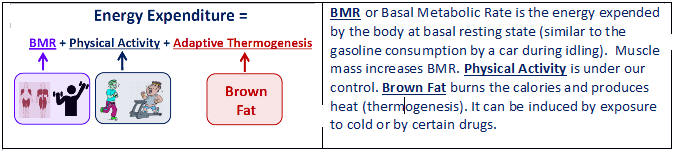
When we are young, the BMR or the energy spent during resting periods is
relatively higher. But as we age, it decreases due to various reasons. One of
them is gradual loss in muscle mass. By regularly doing muscular exercises (dumb
bells, or tension exercise with weights) one can retain the muscle mass and thus
keep up the BMR while aging. One can also burn a large amount of extra calories
by regular physical activity, such as jogging or walking on treadmill. This type
of exercise, referred to as cardiovascular, also improves heart function and
keeps it healthy. Adaptive Thermogenesis is production of heat, instead of
energy, from the extra calories. This is regulated by brown fat, which is small
in amount, but is considered as the good fat. Unlike white fat, which is in
bulk, brown fat has the machinery to burn the calories and produce heat. It is
more prominent in infants. Recently, a lot of interest has been generated about
brown fat or browning of fat, because thermogenesis conferred resistance to
obesity in experimental animals, and correlated with leanness in humans. So,
already some pharmaceutical companies are working to develop drugs to induce
browning of fat to treat obesity. So, the healthy way to lose weight is entirely
in our hands. While following the above guidelines, one has to watch what one is
eating. For example, the type of oil we use in cooking is a critical determinant
of driving our energy metabolism in good or bad direction. It is recommended to
use oils rich in unsaturated fatty acids, such as virgin olive oil or grape seed
oil. Cutting down carbohydrates, such as rice, or replacing it with wheat-based
bread or roti or chapatis, will also help. It is not necessary to cut down all
the fat in the food, and that is actually not good for health. Aikins diet,
which recommends a low carb and high protein and fat diet will work well to lose
weight quickly, but it can harm your kidneys and other vital organs in the long
term. The best is to balance all components of diet and keep an eye on the total
calories consumed per day. Regular consumption of fruits and vegetables and
dairy products will also help to lose weight. Sodas containing fructose will
harm the body by disturbing the glucose metabolism, and cause metabolic
syndrome. Human bodies are not tuned to utilize high amounts of fructose as
source of energy. It is like pumping diesel in a gasoline car. If we take care
of our bodies just as we take care of our cars by diligently following
manufacturer"s instructions, then there is no problem at all. One good thing
about losing weight is, it will control or even reverse diabetic condition.
* Videos to Watch:
My Big Fat Body
https://www.youtube.com/watch?v=qY3iExEYr7w
The Weight of the Nation: Part 1
https://www.youtube.com/watch?v=-pEkCbqN4uo
Future of Food - Part 1: India (BBC Documentary)
https://www.youtube.com/watch?v=u7J2UbE8yw4
* Sources of Information Used in Preparing this Article: US Centers for Disease
Controls (CDC); National Institute of Diabetes and Digestive and Kidney Diseases
(NIDDK); National Obesity Foundation; Wikipedia.