Health hazards of Night and Shift Work
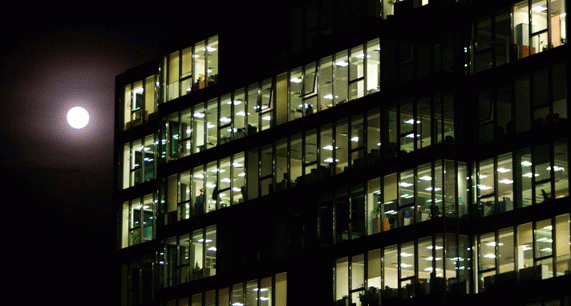
Shift work is any work done outside the normal daylight hours of 7 A.M. to 6
P.M. Shift work includes evening and night work, as well as overtime or
extra-long workdays. Shift work also includes people in regular day jobs who
bring their work home and work late at night on their computers on a regular
basis. Shift work poses unique challenges to the body and increases the risk of
many diseases. Shift work became popular during the Second World War when the
war demanded rapid production of goods and arms. Following the war, there was
also a great demand for industrialized goods to rebuild Europe. The march has
been relentless since then, and now, all factories try to run 24 hours a
day, 7 days a week (24×7), lest they are out-produced by their competitors. This
has given rise to this 24×7 work culture which poses a significant hazard to
personal and public health. Now, some may wonder why this is important; I only
work the regular 9-5 shift. This is important to all, as facilities on which the
public depends tend to run 24×7. Thus, these facilities are also prone to
accidents due to shift-work. Fatigue related to shift work and sleep deprivation
have been attributed to industrial disasters like:
1. Nuclear accident at Three Mile Island, Pennsylvania in 1979
2. Chemical accident at the Union Carbide plant in Bhopal, India, in 1984
3. Nuclear accident at Chernobyl in Ukraine in 1986
4. Explosion of Challenger space shuttle in 1986
5. The Exxon Valdez Oil Spill in Alaska, USA in 1989
Most industries employ people in eight-hour shifts across the 24x7. These are
the day shift (from 8 A.M. to 4 P.M.), the evening or swing shift (from 4 P.M.
to 12 P.M.), and the night or graveyard shift (from 12 P.M. to 8 A.M.). It is
estimated that 15-20% of workers in industrialized countries are employed in
shift work. About 22 million Americans are involved in shift work across various
sectors. Examples include health care, food service, retail, transportation,
manufacturing, call centers, and public-safety industries like police officers,
fire fighters, military, and security guards. Research suggests that shift
workers (night workers) are more likely to sleep less, work more hours, and
drive drowsy at least once a month and have poorer overall health when compared
with non-shift workers.
Shift work is a major challenge among the Indian community which includes those
living in India as well as the Non Resident Indians (NRI). Many Indians are
employed in call centers at Bangalore, Mumbai, Hyderabad, Kolkata and other big
cities. They provide customer care, technical support and other services to
clients across the world, mainly in Europe and America. But they have to work
irregular hours because of the time zone differences. Many Indians living in USA
are employed in Information Technology. Many can work from home but have to
travel frequently to different cities across time zones and other countries
causing sleep disruptions. Other Indians employed in the medical sector, working
as doctors, nurses, pharmacists, are engaged in shift work to provide round the
clock service for patients. Then, there are those employed in gas stations and
other stores working the night shift. Thus, a significant number of Indians are
involved in shift work without being aware of the dangers it poses to their
health and wellbeing.
How is shift work injurious to individual health?
Human physiology is the product of millions of years of evolution whereby
the norm had humans staying awake during day and sleeping at night. The modern
assault on this sleep-wake cycle (also called the circadian rhythm) may have
dire health consequences. The hormone melatonin which is produced at night
during sleep is also the most powerful antioxidant in nature. When we are awake
and exposed to light, melatonin production is suppressed. Shift work-specially
night work has been associated with increased risk of cancer, obesity, diabetes,
heart disease, digestive problems and menstrual irregularities. Multiple studies
have documented a link between night shift work and the increased incidence of
breast cancer. In one such study, researchers in Denmark found that women who
worked night shifts were up to four times more likely to develop breast cancer
than women who didn’t work nights. The World Health Organization has listed
shiftwork disrupting sleep-cycle as a probable carcinogen. Working at night
causes disruption with hormones that regulate our hunger and appetite. People
staying up late at night will have cravings for sugar and more likely to binge
on junk food. A high incidence of obesity and diabetes is thus seen in people
who work more at nights. Additionally, shift work increases the risk of
developing cluster headaches, heart attacks, sexual dysfunction, depression,
dementia, and reproductive disorders. Shift work has also been associated with
problems like increased smoking and use of recreational drugs.
As physicians, we regularly advise our patients about the importance of diet,
exercise, and sleep for healthy living. But, when it comes to sleep, we do not
always practice what we preach. Medical professionals are one of the most sleep
deprived groups. The health care industry has to provide round the clock care to
the critically sick. Health care services thus have to run 24x7 which poses
double dangers. The doctors and nurses doing shift work, when fatigued and sleep
deprived, make more mistakes, and these medical errors contribute to higher
patient morbidity and mortality. A study published in New England Journal of
medicine found that physicians in their first year of training made
substantially more serious medical errors when they worked frequent shifts of 24
hours or more. Secondly, the shift workers are more likely to get into traffic
accidents when they drive home after a full night of patient care. According to
A study co-funded by the National Institute for Occupational Safety and Health (NIOSH)
found that first-year doctors in training who work shifts of longer than 24
hours are more than twice as likely to have a car crash leaving the hospital and
five times as likely to have a "near miss" incident on the road as medical
interns who work shorter shifts.
Treatment Options: Maintaining healthy sleep hygiene can mitigate some of the
dangers. If you are in a shift work, try to get as much sleep possible on your
rest days. Try to have a nap before and after the shift work. Although caffeine
can cause sleep problems in many, it can be beneficial for shift work to
increase wakefulness and reduce errors. Research has shown that shift-workers
who take prophylactic naps have reduced errors. There are also medications
available which can promote sleep as well as wakefulness. Melatonin is safe and
non-addictive choice, both for short- and long-term use. It helps to restore and
increase sleep for night workers. Light inhibits melatonin. It has been seen
that blue light causes maximum reduction in melatonin. Avoidance of bright light
(especially blue) at night improves body’s melatonin production. This can be
done by keeping the room dark, use of dark glasses, as well as minimizing blue
light found TV, computer, laptop, phone, and tablet screens. Other medications
like stimulants are used to promote wakefulness but not routinely recommended as
side effects outweigh the benefits. Similarly, there are sedatives and hypnotics
which can promote sleep and work wonders in the short-term for a sleep-deprived
person, but their long-term use needs careful oversight by a doctor.
In summary, shift work is disruptive to our sleep and well-being. Unless one is
careful and take steps to mitigate the sleep disruption caused by shift-work,
one may endanger his well-being and the safety of others. The science of sleep
and shift work has been translated into political action, and safety regulations
have now been created for various industries in recognition of the dangers of
shift work. The importance of sleep requires more public and personal awareness
to increase safety. Laws and regulations can only go so far. Unless, everyone
becomes aware on the life-giving property of sleep and makes it a priority,
fatigue-related accidents will continue to occur. Additionally, we will continue
to see a surge of cancer, obesity, heart disease, diabetes, depression, and
other life-style illnesses whose incidence can be reduced with improved sleep.
Fortunately, there are ways by which we can reduce the damage caused by
shift-work. Use of timely scheduled naps, creating dark rooms during the day
time, avoiding stimulants and other sleep disruptive chemicals, and using over
the counter melatonin are some of the remedies. If you do shift work and your
sleep and wellbeing remains compromised after all your efforts, consult a
doctor. Also you can contact the national institute for occupational Safety and
Health at the number 1-800-35-NIOSH for more information on your rights and
options.